How Laser Energy Works: Selective Photothermolysis
The main different types of laser hair removal include Alexandrite (755 nm) for rapid, precise treatment on fair skin; Diode (808–810 nm) for versatile hair reduction across most skin phototypes; and Nd:YAG (1064 nm) for safe, deep follicular targeting on darker skin tones. Each system utilizes a specific wavelength to deliver thermal energy directly to melanin in the hair root while preserving surrounding skin tissue.
All laser hair removal systems rely on the scientific principle of selective photothermolysis. First conceptualized in the 1980s, this process matches specific light wavelengths and pulse durations to target a designated chromophore (in hair removal, eumelanin pigment) to disable hair follicles thermally without damaging surrounding skin.
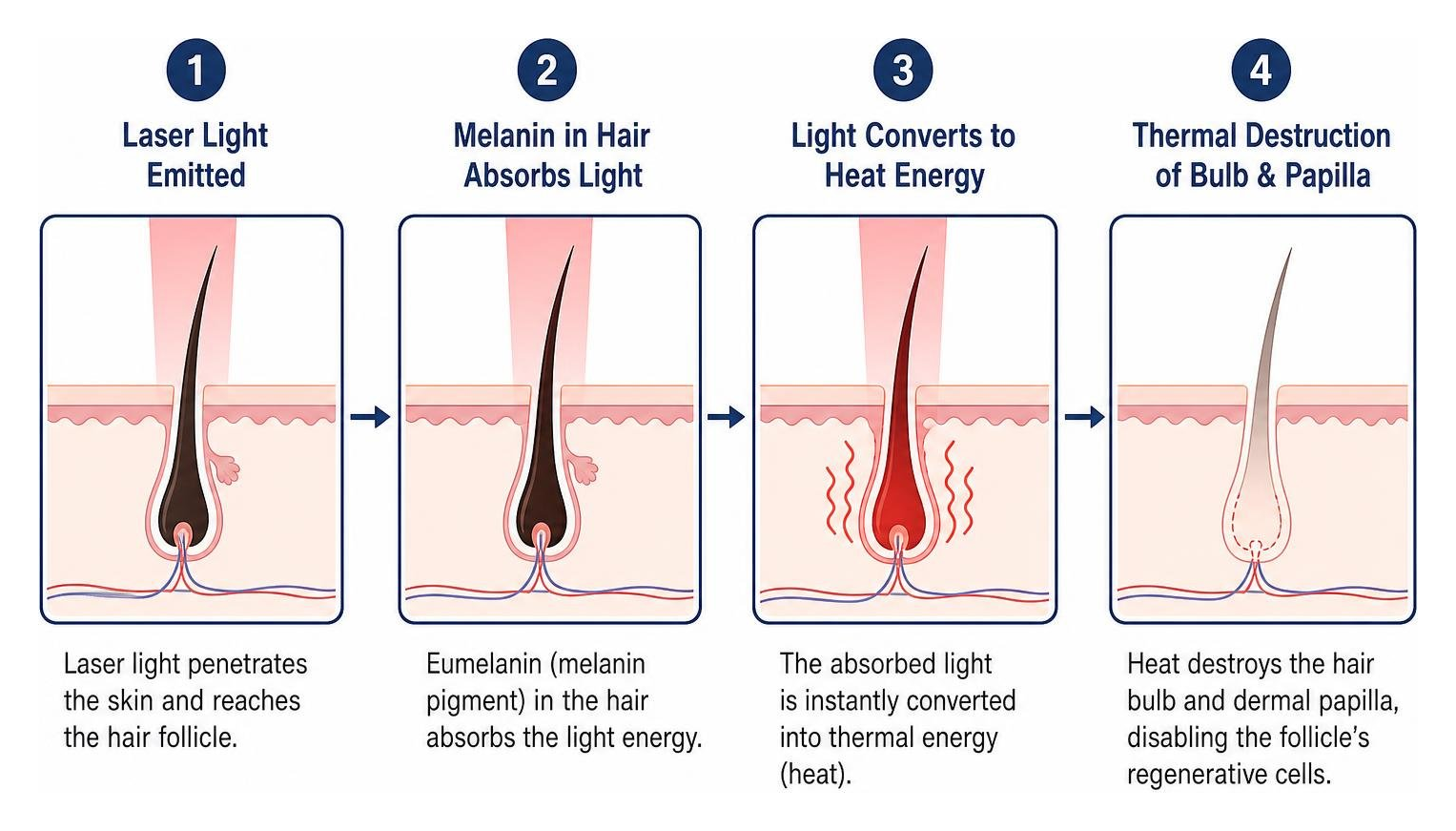
To disable the follicle permanently without blistering or burning the surface skin, the laser pulse must deliver heat within a specific window called the thermal relaxation time (TRT). TRT is the time required for a target structure to lose 50% of its peak heat. Because the hair follicle is larger than microscopic skin cells, it holds onto heat longer. A properly calibrated laser delivers a pulse long enough to destroy the follicle’s regenerative cells, while built-in cooling prevents the surrounding skin from overheating.
This process is closely tied to your natural hair growth cycles:
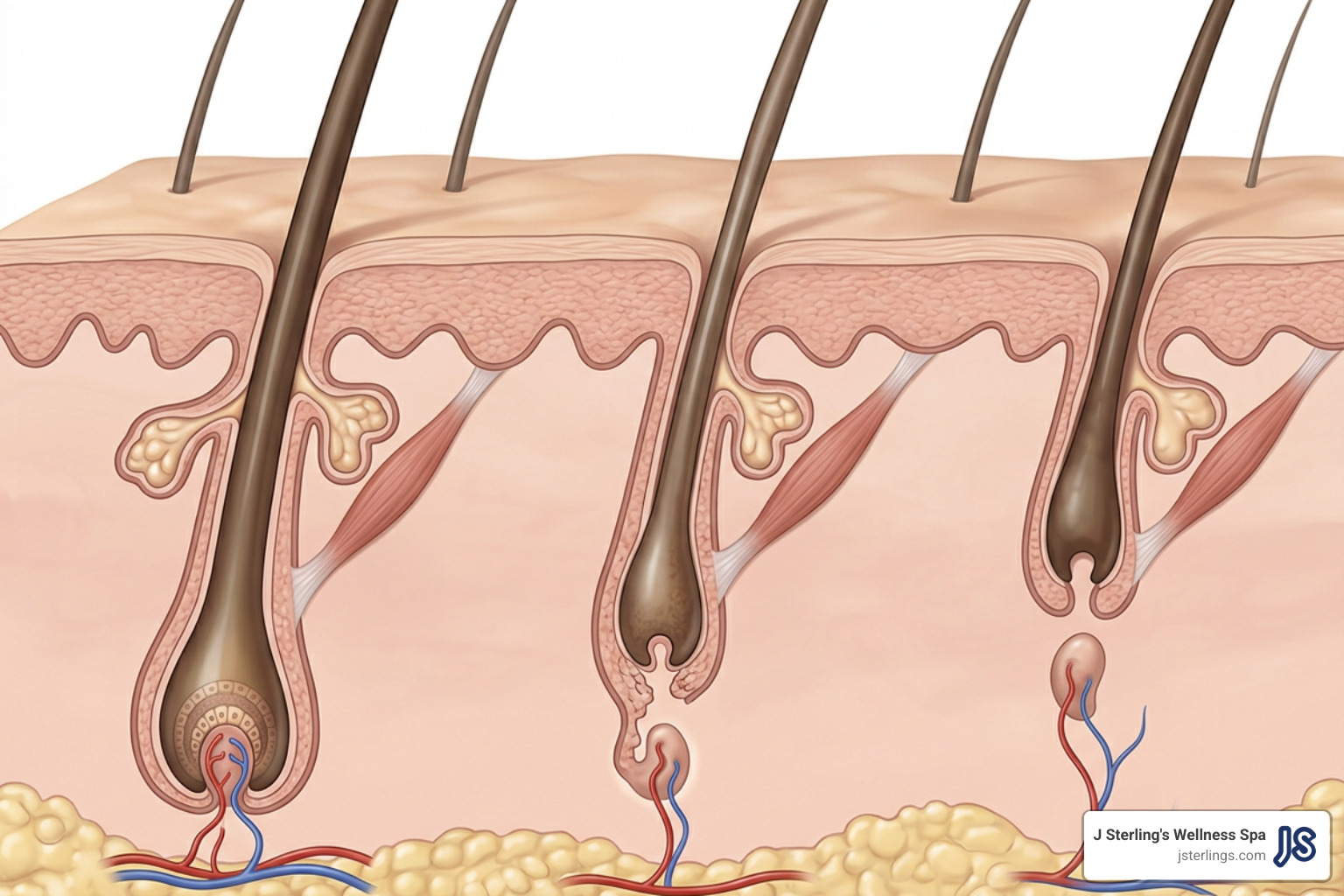
- Anagen (Active Growth): The hair shaft contains abundant melanin and is physically attached to the dermal papilla and follicle stem cells. This is the only phase where laser energy can effectively destroy the regenerative base.
- Catagen (Transitional Phase): The follicle detaches from its blood supply, and melanin production slows down.
- Telogen (Resting Phase): The old hair rests before shedding; the follicle base is dormant and largely unresponsive to laser energy.
Because only 10% to 20% of your body hair is in the anagen phase at any given moment, multiple sessions are required to catch every follicle during its active growth window. For a deeper scientific breakdown of this process, review the clinical study on laser hair removal principles (Vaidya et al., 2023). For a broader overview of treatment logistics, you can also explore our comprehensive laser hair removal guide.
How Different Types of Laser Hair Removal Target Melanin
The biological secret to laser hair removal is targeting the hair’s root machinery. High concentrations of eumelanin reside within the hair matrix and cortex. When the laser fires, light passes through the upper layers of the skin, targeting this pigment reservoir.
The absorbed thermal energy travels downward through the hair shaft into the dermal papilla (the blood supply feeding the follicle) and the follicular stem cells nestled in the follicular bulge. If these structures reach approximately 65°C to 70°C, the proteins denature, permanently disabling the follicle’s ability to sprout new terminal hair.
To achieve this safely across different skin types, certified laser specialists adjust parameters like pulse duration (how long each blast of light lasts) and fluence (energy delivered per unit area).
True Lasers vs Intense Pulsed Light (IPL)
One of the most common misunderstandings in the aesthetic industry is confusing true medical lasers with Intense Pulsed Light (IPL). While both use light energy, their physics and clinical results are fundamentally different.
| Feature | True Medical Lasers (Alexandrite, Diode, Nd:YAG) | Intense Pulsed Light (IPL) |
|---|---|---|
| Light Spectrum | Monochromatic: A single, pure wavelength (e.g., 755 nm, 810 nm, 1064 nm) | Polychromatic: Broad-spectrum light (typically 500 nm to 1200 nm) |
| Beam Structure | Coherent & Collimated: Light waves travel parallel in a focused, concentrated beam | Incoherent & Divergent: Light scatters outward, similar to an intense flashbulb |
| Depth Precision | Directly penetrates to the depth of the hair bulb with minimal energy waste | Energy scatters across various skin depths, losing power before reaching deep roots |
| Skin Safety | Highly customizable; specific wavelengths safely bypass surface melanin on dark skin | Carries higher epidermal burn risks for medium-to-dark skin due to wide light spread |
| Typical Efficacy | 70%–85% reduction within 6–8 sessions | 50%–70% reduction, often requiring 10–14+ sessions and frequent touch-ups |
True lasers emit a focused, monochromatic beam designed to reach deep dermal follicles while keeping surrounding tissue safe. In contrast, IPL spreads energy across multiple skin depths, making it useful for surface issues like sunspots, but less efficient for deep, coarse hair.
Comparing the Different Types of Laser Hair Removal Technologies
Different laser systems use distinct crystal or semiconductor mediums to produce specific wavelengths of light. Choosing the correct wavelength is the single most important factor in balancing safety and hair reduction.
| Laser Technology | Primary Wavelength | Melanin Absorption | Skin Depth Penetration | Best Fitzpatrick Skin Types | Average 12-Month Hair Reduction |
|---|---|---|---|---|---|
| Ruby | 694 nm | Extremely High | Superficial | Types I–II | 70%–90% |
| Alexandrite | 755 nm | High | Moderate | Types I–III | 70%–85% |
| Diode | 808–810 nm | Moderate | Deep | Types I–V | 70%–80% |
| Nd:YAG | 1064 nm | Low / Controlled | Very Deep | Types IV–VI (Safe for all) | 60%–70% |
| IPL (Not a laser) | 500–1200 nm | Variable (Broad) | Superficial to Moderate | Types I–III | 50%–70% |
Understanding these wavelength comparisons for skin types helps ensure you receive an effective treatment tailored to your specific genetic profile.
Alexandrite Laser (755 nm): Speed and Precision for Fair Skin
The Alexandrite laser operates at a 755 nm wavelength, sitting directly in the sweet spot for maximum melanin absorption.
- How it works: Because 755 nm light is readily absorbed by eumelanin, this laser requires less overall energy to disable hair roots quickly.
- Best Candidates: Individuals with Fitzpatrick skin phototypes I through III (fair, ivory, and light olive skin) paired with dark, pigmented hair.
- Clinical Performance: Studies demonstrate an average 70% to 85% hair reduction after a full series of 6 to 8 sessions.
- Key Advantages: Alexandrite lasers feature high repetition rates and large spot sizes (up to 18–24 mm). This makes treating large surface areas, such as legs or chests, quick and efficient. It is also exceptionally effective for smaller, sensitive spots like underarm laser hair removal.
- Limitations: Because surface melanin absorbs 755 nm light so quickly, this laser poses a higher risk of burns, blisters, or post-inflammatory hyperpigmentation if used on medium-deep to dark skin tones.
Diode Laser (808–810 nm): The Versatile Workhorse
The Diode laser, operating between 808 nm and 810 nm, is one of the most widely used platforms in clinical aesthetic practices.
- How it works: Its mid-range wavelength strikes a balance between melanin absorption and deep tissue penetration. It bypasses upper-level skin pigment more effectively than the Alexandrite, while still delivering enough thermal energy to heat the follicle matrix.
- Best Candidates: Suitable for a broad spectrum across Fitzpatrick skin types I through V, making it safe for fair, olive, Mediterranean, and light brown complexions.
- Clinical Performance: Clinical trials show an average 57.9% reduction after just 3 sessions, expanding to 70% to 80% hair reduction at the 12-month mark.
- Key Advantages: The deeper penetration of the 810 nm beam makes it ideal for dense, deeply rooted hair, such as men’s back and chest hair or stubborn bikini lines. Modern diode platforms include advanced contact cooling tips, which significantly improve comfort; learn more about pain management and comfort levels during laser treatments.
Nd:YAG Laser (1064 nm): Safe Precision for Darker Skin Tones
The Neodymium-doped Yttrium Aluminum Garnet (Nd:YAG) laser produces light at a 1064 nm wavelength, making it the gold standard in safety for deeply pigmented skin.
- How it works: The 1064 nm wavelength has a lower melanin absorption rate, meaning the laser beam passes directly past the melanin-rich epidermis (the surface of your skin) without overheating it. Instead, the energy travels deep into the dermis to target the blood supply and deep root of the hair follicle.
- Best Candidates: Specifically engineered for Fitzpatrick skin types IV, V, and VI (olive, caramel, rich brown, and deep black skin tones).
- Clinical Performance: Delivers 60% to 70% long-term hair reduction across 8 to 10 treatment sessions.
- Key Advantages: It provides unmatched safety against thermal burns, keloid scarring, and post-inflammatory hyperpigmentation (PIH) for darker complexions. Additionally, Nd:YAG lasers are frequently utilized for vascular therapies and deep folliculitis management.
Dual-Wavelength Systems and Ruby Lasers (694 nm)
Modern laser technology has evolved beyond single-crystal platforms:
- Dual-Wavelength Blending: Many advanced aesthetic clinics utilize dual-wavelength systems that house both a 755 nm Alexandrite and a 1064 nm Nd:YAG crystal inside a single chassis. These devices allow certified practitioners to switch between wavelengths or emit them in rapid succession, making it easy to tailor treatments for individuals with mixed skin tones, hormonal hair patterns, or seasonal tans.
- Ruby Laser (694 nm): The historical foundation of aesthetic laser epilation. The 694 nm ruby laser exhibits the highest melanin absorption profile of any platform, yielding 70% to 90% hair clearance on very fair skin. However, its shallow penetration depth, slow repetition rates, and high risk of pigmentary changes on anything other than porcelain-white skin (Fitzpatrick Type I) have made it largely obsolete in modern clinics.
Matching Laser Technology to the Fitzpatrick Skin Scale
To choose the right laser platform, providers use the Fitzpatrick Skin Phototype classification system, which evaluates how your skin reacts to ultraviolet light and measures your epidermal melanin density.
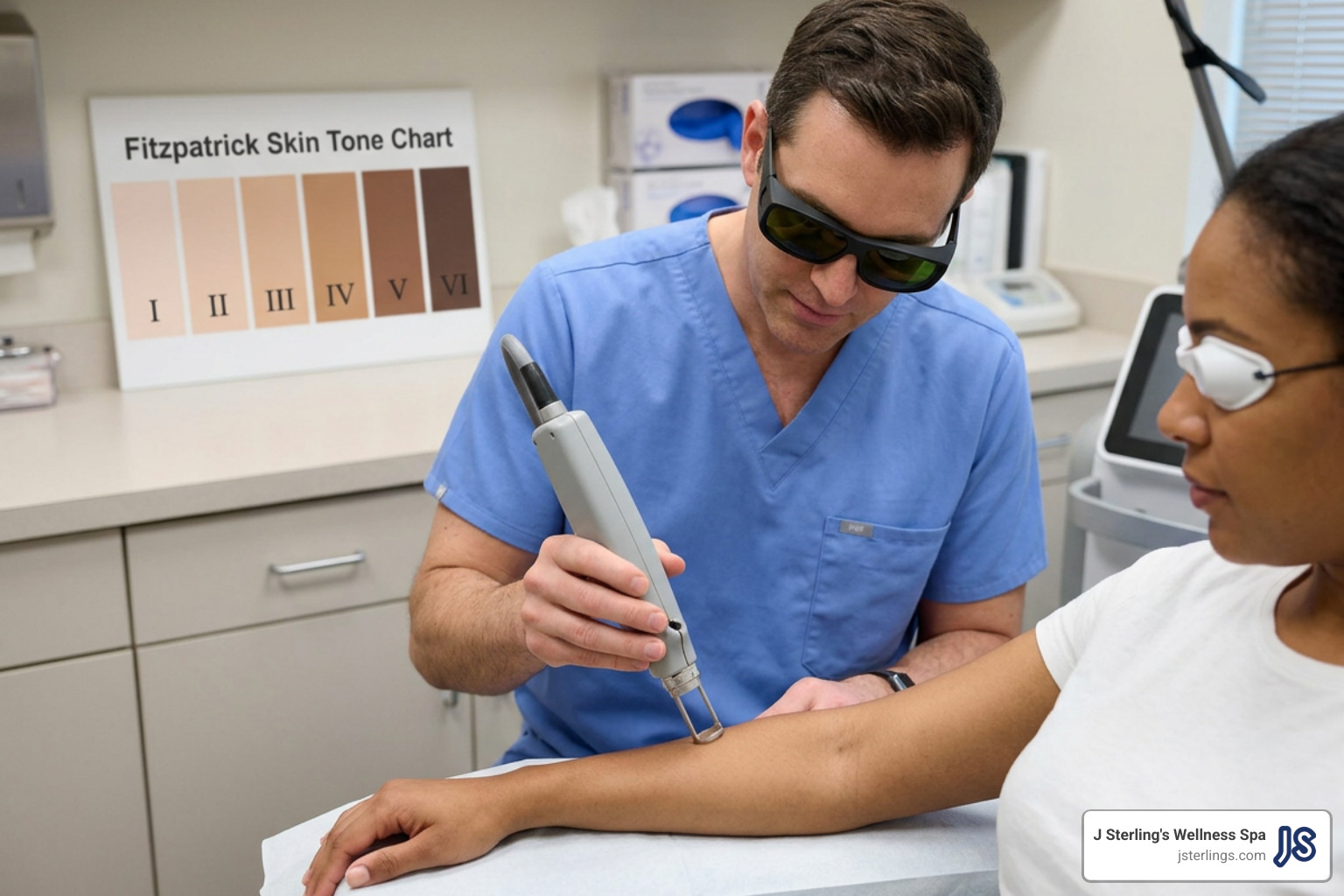
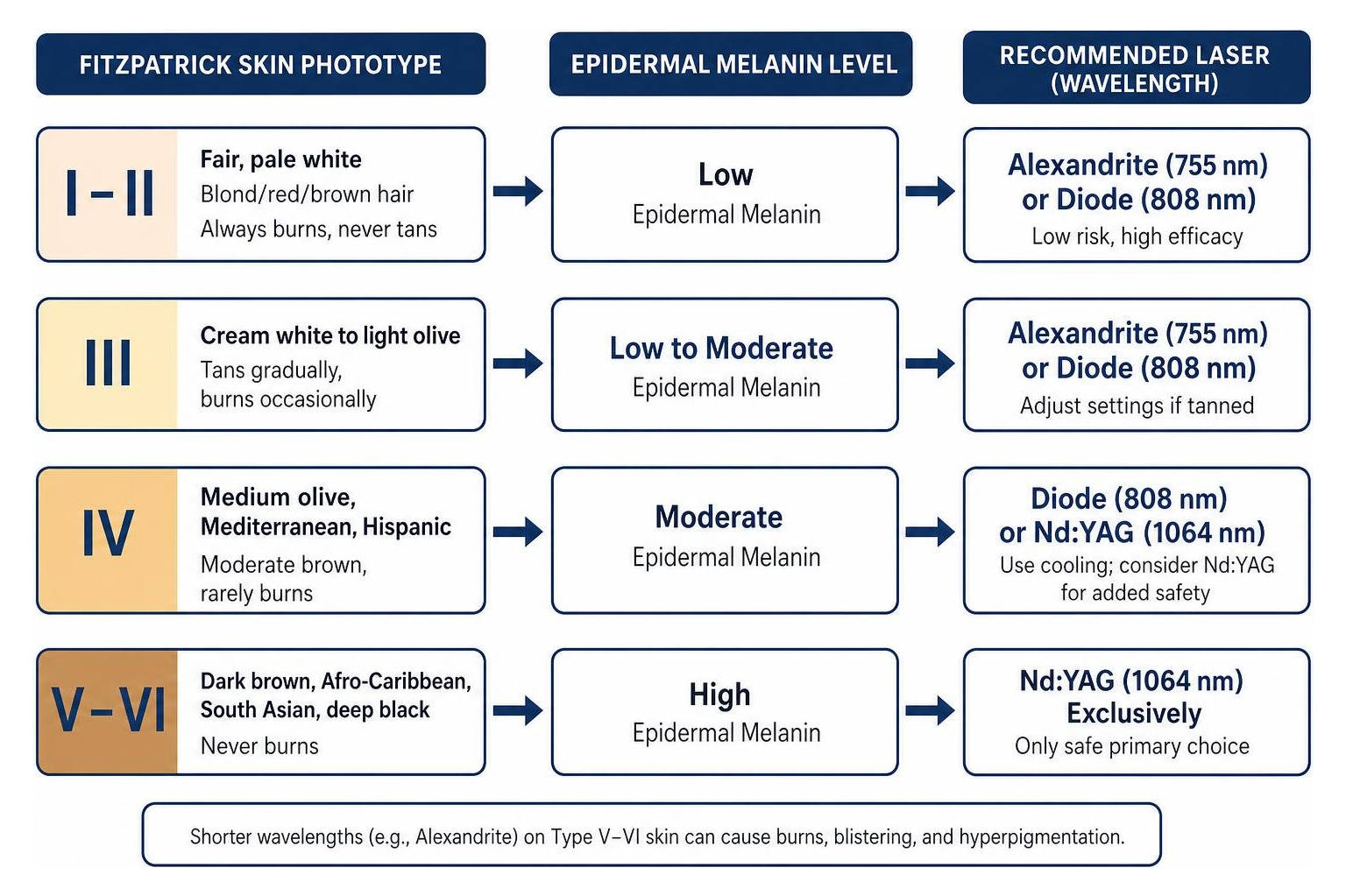
- Fitzpatrick Types I & II (Fair, pale white, blond/red/brown hair, always burns, never tans): Melanin is almost entirely concentrated inside the hair follicle rather than the skin. The Alexandrite (755 nm) or Diode (808 nm) laser delivers rapid, high-energy treatments with minimal risk of skin irritation.
- Fitzpatrick Type III (Cream white to light olive, tans gradually, burns occasionally): A versatile skin type that responds well to both Alexandrite and Diode lasers. Providers may adjust pulse durations slightly to protect the skin during summer months when a tan is present.
- Fitzpatrick Type IV (Medium olive, Mediterranean, Hispanic, moderate brown, rarely burns): Requires careful laser calibration. The Diode (808 nm) with active skin cooling is widely used, though providers often transition to an Nd:YAG (1064 nm) to keep the epidermis safe and comfortable.
- Fitzpatrick Types V & VI (Dark brown, Afro-Caribbean, South Asian, deep black, never burns): The Nd:YAG (1064 nm) laser is the only safe primary choice. Using shorter wavelengths like the Alexandrite on Type V or VI skin can lead to superficial burns, blistering, and hyperpigmentation.
Understanding how your phototype interacts with light energy ensures you can achieve long-term skin smoothness while keeping your skin barrier protected. For general clinical recommendations, refer to the Mayo Clinic’s Laser Hair Removal overview.
Choosing Between Different Types of Laser Hair Removal for Coarse vs Fine Hair
Beyond skin phototype, your hair’s physical characteristics—specifically its diameter and growth depth—play an important role in how we configure treatment settings:
- Coarse, Thick Hair (Bikini line, underarms, men’s beards): Coarse hairs have a large diameter and a heavy concentration of melanin, absorbing heat rapidly. These hairs respond exceptionally well to longer pulse widths on Diode and Nd:YAG platforms, which slowly heat the follicle to avoid skin irritation.
- Fine, Intermediate Hair (Arms, thighs, peach fuzz): Fine hairs hold smaller amounts of pigment, meaning heat dissipates quickly. These require shorter pulse durations and higher fluence, often making the Alexandrite (755 nm) the most effective option for lighter skin types.
- Preventing Paradoxical Hypertrichosis: Applying low-energy, sub-therapeutic laser or IPL pulses to fine, non-terminal vellus hair (especially on the female jawline, neck, or upper arms) can unintentionally stimulate dormant follicles, causing fine hair to grow back thicker. Certified practitioners prevent this by avoiding low-energy IPL settings on fine facial hair and using true lasers calibrated to proper thermal thresholds.
Reducing Risks and Pigmentation Changes for Darker Skin
Treating melanin-rich skin safely requires advanced epidermal cooling technologies alongside conservative laser settings:
- Contact Cooling Tips: Chilled sapphire or copper crystal handpieces continuously cool the skin surface down to 4°C to 5°C before, during, and immediately after each laser pulse.
- Cryogen Dynamic Cooling Devices (DCD): An automated system that sprays a millisecond burst of liquid cryogen onto the skin just prior to the laser pulse, cooling the upper epidermis while letting heat penetrate the deeper follicle.
- Chilled Air Blowers: Systems that direct a continuous stream of cold air (-30°C) across the treatment area to keep the skin comfortable throughout the session.
- Patch Testing Protocols: For Fitzpatrick IV–VI clients, providers perform localized test spots 24 to 48 hours before treating a full area to verify skin tolerance and prevent post-inflammatory hyperpigmentation.
Treatment Protocols, Session Timelines, and Regrowth Factors
Achieving lasting hair reduction requires consistency, proper spacing, and realistic clinical expectations.

The Treatment Schedule
Because laser light only targets follicles in the active anagen growth stage, sessions must be scheduled to match your body’s natural hair cycles:
- Facial Areas (Upper lip, chin): Treated every 4 to 6 weeks due to faster hair turnover.
- Body Areas (Underarms, bikini, legs, back): Treated every 6 to 8 weeks to catch resting follicles as they cycle back into anagen.
Permanent Hair Reduction vs. Complete Removal
The U.S. FDA classifies laser systems for permanent hair reduction rather than permanent hair removal. In clinical terms, this means you can expect a long-term, stable reduction in hair count—typically 70% to 90% clearance after a completed series of 6 to 8 sessions. Surviving hairs often regrow much finer, lighter, and softer. By comparison, only needle electrolysis is cleared for total permanent hair elimination, though it treats just one individual hair at a time.
Why Hair May Regrow in Certain Areas
Occasional regrowth after a full treatment series usually stems from internal biology rather than laser performance:
- Hormonal Flux and Androgens: Changes during pregnancy, menopause, or fluctuating testosterone levels can activate previously dormant stem cells.
- PCOS (Polycystic Ovary Syndrome): Women managing PCOS often experience ongoing facial hair development due to elevated androgen levels. While laser epilation significantly reduces hair thickness and skin irritation, clients with PCOS typically benefit from quarterly touch-up sessions.
- Androgen-Sensitive Zones: The chin, neck, and bikini area have higher concentrations of hormone receptors, making them more prone to gradual regrowth over the years.
Essential Questions to Ask Your Laser Provider
Before booking your first appointment, make sure your provider is well-equipped to treat your skin and hair type safely:
- What exact laser technology and wavelength do you use in your clinic (Alexandrite, Diode, Nd:YAG, or IPL)?
- Is your machine cleared by the FDA for my specific Fitzpatrick skin phototype?
- Are your laser technicians certified, licensed, and experienced with darker skin tones?
- Do you perform a pre-treatment test patch to check for pigment changes?
- What integrated skin-cooling systems does your equipment use to minimize pain and protect the skin barrier?
Preparation and Post-Care Best Practices
To ensure a safe treatment and get the best results from each session:
- Pre-Care: Shave the area with a clean razor 12 to 24 hours prior to your session. Avoid waxing, plucking, threading, and chemical epilators for at least 4 to 6 weeks before your appointment so the hair roots remain intact. Discontinue topical retinoids and alpha-hydroxy acids (AHAs) on the area for 3 to 5 days prior.
- Post-Care: Apply pure aloe vera gel or cold compresses if you notice mild redness or swelling around the follicles (perifollicular erythema). Avoid hot tubs, saunas, strenuous workouts, and direct sun exposure for 24 to 48 hours. Always wear broad-spectrum SPF 30+ sunscreen daily over treated areas.
To explore affordable options for your treatment plan, check out our affordable laser hair removal options.
Frequently Asked Questions About Laser Hair Removal Types
Which laser technology is considered the safest for deep skin tones?
The 1064 nm Nd:YAG laser is widely recognized as the safest choice for deeply pigmented skin (Fitzpatrick types IV through VI). Its longer wavelength passes safely through the melanin-rich epidermis, directing its heat deeper into the dermis to disable the hair follicle and its blood supply without causing burns or hyperpigmentation.
Why is laser hair removal labeled permanent reduction instead of removal?
The FDA uses the term “permanent reduction” because laser energy targets active follicles during the anagen phase, reducing the overall number and thickness of hairs over time. However, it cannot prevent the body from developing entirely new hair follicles down the road due to hormonal shifts, genetics, or natural aging.
How many sessions are realistically needed for lasting hair reduction?
Most individuals require an initial series of 6 to 8 sessions, spaced 4 to 8 weeks apart, to achieve significant, long-lasting reduction (typically 70% to 90% clearance). Hormonally active areas, such as the chin or neck, may require 8 to 12 sessions alongside occasional maintenance visits.
Conclusion
Finding the right laser hair removal technology comes down to understanding the relationship between your skin tone, hair texture, and the physics of light wavelengths:
- Alexandrite (755 nm): Unmatched speed and precision for fair to light-olive skin with dark hair.
- Diode (808–810 nm): A versatile, comfortable platform suited for medium to olive skin types.
- Nd:YAG (1064 nm): The dedicated, safe standard for rich, deep skin tones.
At J Sterling’s Wellness Spa, we believe professional aesthetic care should be both luxurious and accessible. Across our convenient Florida locations—including Altamonte Springs, Clermont, Lake Mary, Orlando, Winter Park, St. Cloud, and Waterford Lakes—our licensed specialists use advanced laser technologies to provide smooth, long-lasting results for every skin tone.
Ready to leave razor burn, ingrown hairs, and constant waxing behind? Schedule your consultation for personalized professional laser hair removal treatments with our team today!
References
Tanvi Vaidya, Marc H. Hohman, Dinesh Kumar D. “Laser Hair Removal.” StatPearls Publishing, 2023. NBK507861.