How Laser Hair Removal Works: Science, Devices, and Skin Types
At its core, laser hair reduction relies on the physics of selective photothermolysis. This optical process pairs a specific wavelength of light and pulse duration to target a distinct structure in the tissue—the chromophore—without harming adjacent skin layers (Vaidya et al., 2023).
In hair reduction, the primary target chromophore is melanin, the pigment concentrated inside the hair shaft and follicular bulb. When the handpiece emits a concentrated beam of optical energy, melanin absorbs the light and converts it instantly into thermal energy. This heat conducts outward into the surrounding follicular epithelium, disabling the germinative stem cells responsible for generating new hair.
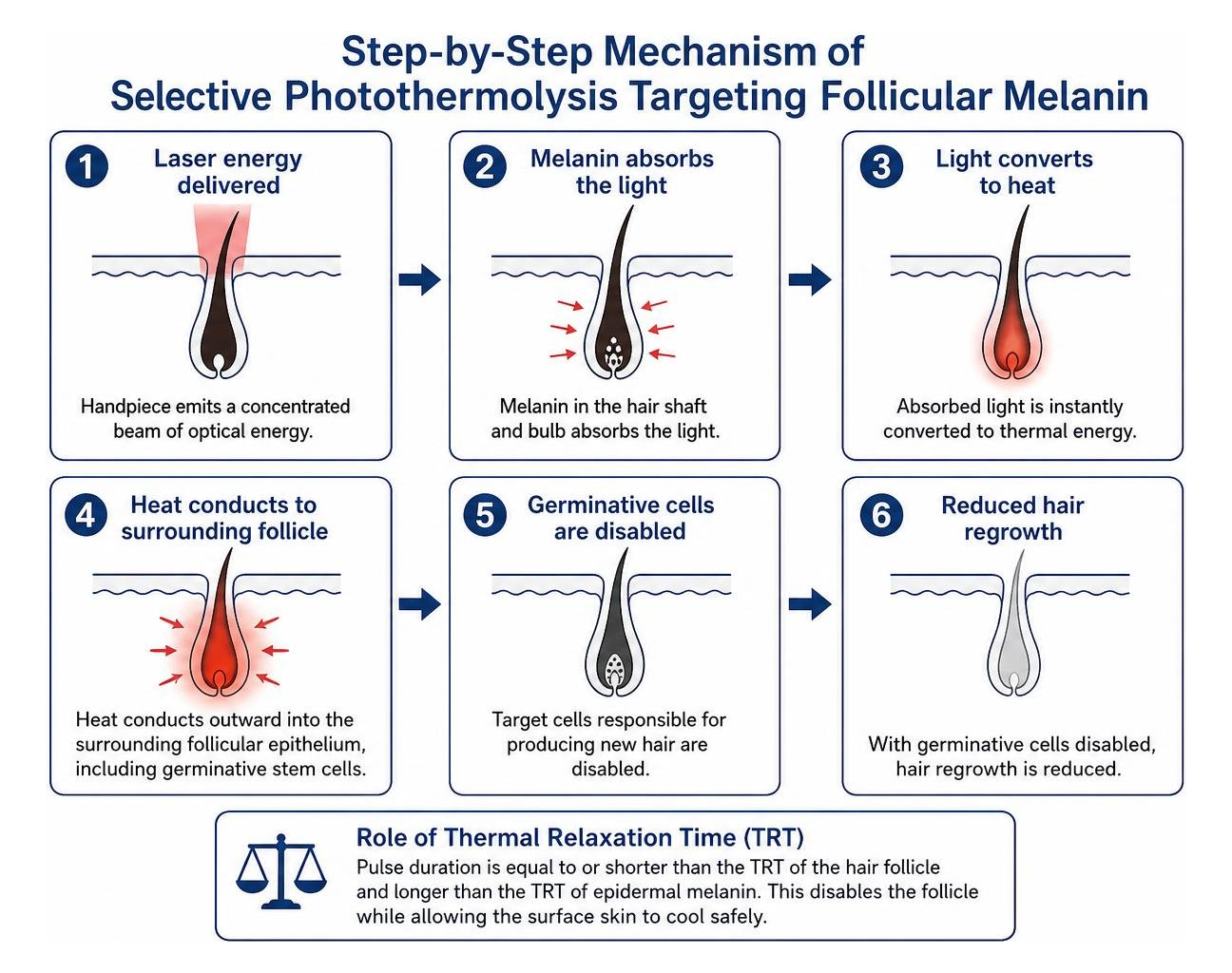
To disable the root without burning the epidermis, the laser’s pulse duration must remain equal to or shorter than the thermal relaxation time (TRT) of the target follicle. Thermal relaxation is the time needed for an object to lose 50% of its absorbed heat. By matching pulse width to the TRT of the hair follicle while keeping it longer than the TRT of the epidermal melanin, the follicle retains destructive heat while the surface skin cools safely. For a deeper medical breakdown of these optical parameters, review the clinical research on selective photothermolysis.
Laser Technologies: Alexandrite, Diode, and Nd:YAG
Different hair colors, skin complexions, and depths require specific wavelengths within the therapeutic optical window (600 nm to 1200 nm). The three leading clinical laser platforms include:
- Alexandrite Laser (755 nm): High melanin absorption makes this wavelength effective for light to olive skin (Fitzpatrick types I–III) with dark, coarse hair. Clinical trials show a six-month hair reduction rate of roughly 68.75% with alexandrite platforms.
- Diode Laser (810 nm): A versatile balance between melanin absorption and tissue penetration depth. Diode systems safely treat Fitzpatrick types I–V. In comparative clinical trials, diode lasers achieved a 71.71% reduction at six months and a 69.2% reduction at 12 months (outperforming IPL systems, which yielded 52.7% at 12 months).
- Nd:YAG Laser (1064 nm): Utilizing a longer wavelength, the Nd:YAG laser bypasses high concentrations of epidermal melanin to target the deep dermal papilla directly. This makes it the standard for Fitzpatrick skin types IV–VI, including deep, dark skin tones.
Advanced devices incorporate continuous epidermal cooling—such as chilled sapphire contact tips, cryogen dynamic cooling bursts, or cold air currents—to protect the surface skin from thermal injury. For clinical safety insights, consult the clinical guide to laser hair reduction.
Who Is an Ideal Candidate for Laser Hair Removal?
The classic ideal candidate has dark, terminal hair and light skin, creating maximum contrast for melanin absorption. However, modern multi-wavelength systems allow safe, successful treatments across diverse skin tones when managed by trained practitioners.
Laser therapy is also a front-line dermatological solution for medical and skin conditions:
- Pseudofolliculitis Barbae: Painful ingrown hairs and follicular inflammation caused by curved hair shafts curling back into the dermis.
- Hirsutism: Excessive terminal hair growth in androgen-dependent patterns, frequently seen in patients with polycystic ovary syndrome (PCOS).
Candidates must understand that white, grey, red, and pale blonde hairs lack sufficient eumelanin to absorb laser energy effectively. If you are concerned about how pulses feel, learn more about managing treatment discomfort and sensations to prepare comfortably for your session.
Hair Removal Methods Compared: Efficacy, Speed, and Permanence
Understanding how laser technology compares to other epilation and depilation modalities helps clarify long-term value and skin health outcomes.
| Feature | Professional Laser | Intense Pulsed Light (IPL) | Professional Waxing | Electrolysis | Traditional Shaving |
|---|---|---|---|---|---|
| Energy / Mechanism | Coherent, monochromatic light | Broad-spectrum, scattered light | Mechanical root avulsion | Galvanic/thermolytic current | Mechanical blade cutting |
| Depth of Action | Deep follicle root & bulb | Superficial to mid-dermis | Follicle bulb (temporary) | Individual follicle stem cells | Epidermal surface only |
| Permanence | Long-term permanent reduction | Semi-permanent reduction | Temporary (3–6 weeks) | Permanent removal | Temporary (1–3 days) |
| Treatment Speed | Fast (Back: 20–30 mins) | Moderate | Moderate (Back: 30 mins) | Very slow (Hair by hair) | Fast |
| Ingrown Hair Risk | Eliminates ingrown hairs | Reduces ingrown hairs | Moderate to high risk | Low risk | High risk |
| Skin Tone Versatility | High (with Nd:YAG) | Low to moderate | Universal | Universal | Universal |
While electrolysis provides follicle-by-follicle destruction, clinical studies show that laser hair reduction is roughly 60 times faster, less painful, and significantly more practical for larger body surfaces. Meanwhile, traditional methods like waxing and shaving fail to alter follicular anatomy, requiring indefinite maintenance. To understand your treatment options, explore our complete laser hair removal guide.
The Treatment Journey: Preparation, Sessions, and Results
Achieving smooth skin requires a multi-step clinical protocol tailored to your hair growth cycle. Because lasers only disable follicles in the anagen (active growth) phase, treatments must be spaced out to target resting follicles as they cycle back into active growth.
During your appointment, a trained specialist cleanses the area, fits you with protective eyewear, and guides the laser handpiece across the skin. Many areas require minimal appointment time; for instance, learn why targeted underarm treatments take only minutes yet provide decades of freedom from daily shaving.
Following your appointment, hair sheds naturally over 5 to 21 days as the damaged root pushes outward. After a standard series of 4 to 8 sessions spaced 4 to 6 weeks apart, patients experience up to 70% to 90%+ long-term hair reduction, with any residual regrowth appearing light, soft, and fine. If you want to expand your aesthetic wellness plan, explore how combining aesthetic treatments can fit your schedule.
Clinical Laser Device Standards and Energy Fluence
Clinical efficacy hinges on balancing several adjustable settings:
- Energy Fluence ($J/cm^2$): The total optical energy delivered per unit area. Insufficient fluence stuns the follicle rather than destroying it, which can cause treatment failure or paradoxical regrowth.
- Spot Size (mm): Larger spot sizes (e.g., 10–18 mm) reduce light scattering in the upper dermis, allowing deeper photon penetration with lower surface energy requirements.
- Pulse Duration (ms): Adjusted to match the specific diameter and thickness of the hair follicle.
For more on device physics and photon delivery, read this scientific overview of light-based epilation.
Safety, Side Effects, and Regulatory Standards

When performed by qualified professionals using medical-grade equipment, laser treatments maintain an exceptional safety record. Standard, expected clinical endpoints include:
- Transient Erythema: Mild redness around the site resembling a light sunburn, typically subsiding within hours.
- Perifollicular Edema: Slight swelling around individual follicle openings, indicating that the root absorbed therapeutic heat.
Rare complications like blistering, crusting, or dyspigmentation (hypo- or hyperpigmentation) typically arise from uncalibrated equipment, recent sun exposure, or choosing the wrong laser for a patient’s Fitzpatrick skin type.
State regulations dictate who may administer laser treatments. In Florida, commercial aesthetic lasers operate under strict medical oversight rules, requiring certified medical directors, licensed physician assistants, nurse practitioners, or electrologists operating under medical protocols. Choosing a reputable wellness spa ensures safety standards, hygienic treatment rooms, and experienced practitioners.
Frequently Asked Questions About Permanent Hair Reduction
Is the treatment completely permanent?
The FDA classifies laser therapy as permanent hair reduction rather than permanent removal. This means that while a large majority of treated follicles are permanently destroyed, biological shifts—such as hormonal fluctuations during pregnancy, menopause, or endocrine changes—can activate dormant stem cells over time. Occasional maintenance sessions once or twice a year keep your skin completely smooth.
How many sessions are required to see optimal results?
Most clients need between 4 and 8 treatments to address all hair cycles effectively. Because only 15% to 20% of your body hair is in the active anagen phase at any given moment, multiple sessions scheduled 4 to 8 weeks apart ensure every follicle is treated at its most vulnerable stage. Clinical data shows up to a 75% hair reduction after just two treatments, climbing to 90%+ upon finishing a full series.
What should you avoid before and after your appointment?
Avoid waxing, plucking, and chemical depilatories for four to six weeks beforehand, as the laser requires an intact hair root within the follicle. Steer clear of direct sunlight and tanning beds for at least two to four weeks before and after care. Post-treatment, avoid hot tubs, saunas, rigorous exercise, and harsh chemical exfoliants for 24 to 48 hours, and apply a broad-spectrum SPF 30+ sunscreen daily.
Conclusion
Modern aesthetic lasers make lasting hair reduction safe, predictable, and accessible. By matching targeted wavelengths, energy fluences, and cooling systems to your individual skin profile, you can eliminate ingrown hairs and daily razor irritation for good.
At J Sterling’s Wellness Spa, we believe top-tier aesthetic wellness should be accessible to everyone. Backed by over 12,000 client reviews and an average 4.9-star rating, our licensed professionals provide expert care across our locations in Central Florida, including Altamonte Springs, Clermont, Lake Mary, Orlando (South Orlando), Winter Park, and Waterford Lakes.
Ready to simplify your routine with long-lasting, smooth skin? Book a personalized laser consultation with our experienced team today.
References
Tanvi Vaidya, Marc H. Hohman, Dinesh Kumar D. “Laser Hair Removal.” StatPearls Publishing, 2023. NBK507861.