Filler Face Lift vs. Traditional Facelift: What You Need to Know First
A filler face lift — also called a liquid facelift — is a non-surgical procedure that uses injectable dermal fillers to restore lost facial volume, support sagging skin, and create a lifted, more youthful appearance without going under the knife.
Here is a quick comparison to help you decide which path may suit you:
| Filler Face Lift | Surgical Facelift | |
|---|---|---|
| Best for | Mild to moderate volume loss, ages 30–55 | Significant skin laxity, jowling, or tissue descent |
| Results last | 1–2 years | 10+ years |
| Downtime | 24–48 hours | 1–2 weeks |
| Reversible | Yes (HA fillers can be dissolved) | No |
| Treats tissue descent | No | Yes |
| Upfront cost | Lower | Higher |
The core difference comes down to what is actually causing your face to change. Volume loss — the gradual hollowing of cheeks, temples, and the jawline — responds well to fillers. Tissue descent — where skin and deeper structures physically sag downward — requires surgery to truly correct.
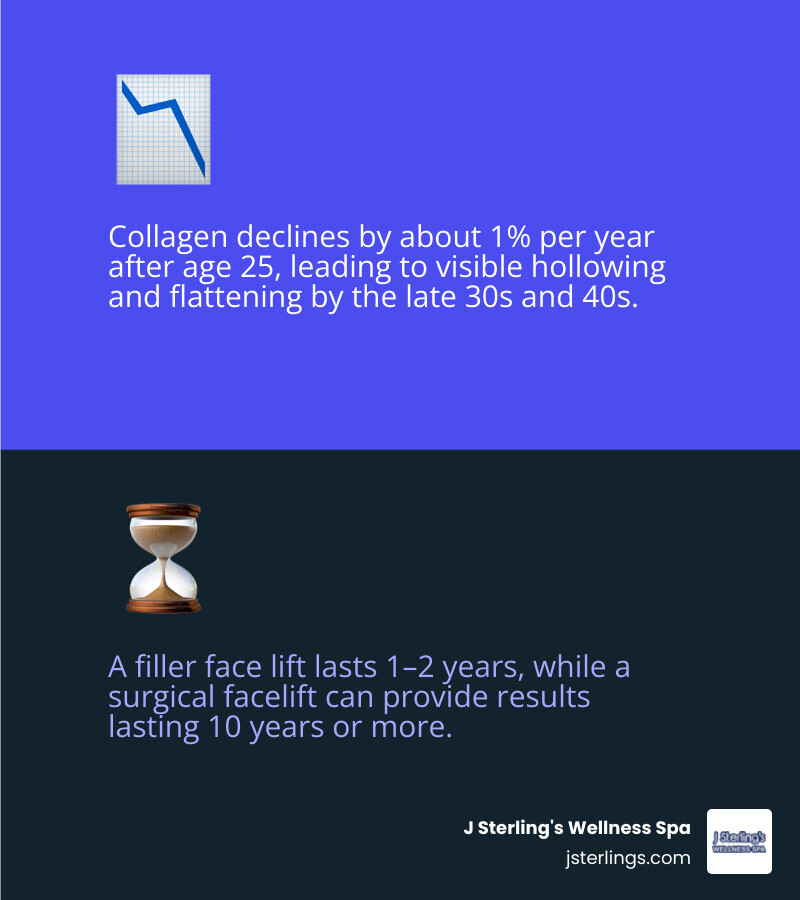
Collagen begins declining by about 1% per year after age 25. By your late 30s and 40s, that loss becomes visible as hollowing and flattening. By your 50s, gravity and loosened ligaments push the conversation toward surgery.
Knowing which process is driving your aging is the single most important step before choosing any treatment.
I’m Max Thakkar, MSc, MBA, Chief Marketing Officer at J Sterling’s Wellness Spa, where I’ve spent over a decade helping Orlando clients navigate affordable, high-quality aesthetic treatments — including understanding when a filler face lift is the right starting point and when it’s time to explore more. That experience shapes everything in this guide.
What Is a Filler Face Lift?
A filler face lift, often called a liquid facelift, is a customized, non-surgical rejuvenation strategy. Instead of using scalpels, sutures, and general anesthesia, this procedure relies on the strategic placement of dermal fillers to rebuild the underlying structural support of your face.
As we age, our face doesn’t just develop surface wrinkles; it undergoes deep, multi-layered structural changes. The goal of a liquid facelift is not to “fill out” individual lines like the lines around your nose or mouth. Rather, it is designed to restore lost volume in key structural zones, which indirectly pulls the overlying skin taut and restores a youthful, rested contour. This non-invasive approach has become incredibly popular for those who want visible refreshment with minimal disruption to their daily lives. Learn more about non-invasive cosmetic procedures to see how these advanced techniques fit into a modern, holistic self-care routine.
How Dermal Fillers Mimic Surgical Lifting
To understand how a filler face lift works, we have to look at the anatomy of facial aging. Our face is supported by a complex scaffolding system: the facial skeleton (bone), deep fat pads, retaining ligaments, and the SMAS (superficial musculoaponeurotic system) layer, which is the muscular sheet that surgeons tighten during a traditional facelift.
As the years pass, this scaffolding begins to fail:
- Bone Resorption: Our facial bones literally shrink, meaning the “canvas” of our face becomes smaller.
- Fat Pad Displacement: The youthful fat cushions in our cheeks deflate and slip downward under the pull of gravity.
- Loosening Connective Tissue: The retaining ligaments that act as support columns lose their elasticity, causing the skin to drape loosely.
When an expert injector performs a liquid facelift, they place dense, high-capacity dermal fillers deep beneath these tissues, often directly against the bone. This acts as a physical prop. By restoring volume to the cheekbones (zygoma) or the temples, the filler acts like a clothes hanger, pulling the sagging skin of the lower face upward. This leverage effect is highly strategic; filling the cheekbones can naturally soften nasolabial folds and marionette lines without ever injecting product directly into them. For a deeper look at this architectural approach to facial rejuvenation, explore Creating Face Lift Effect with Dermal Filler.
Who Is the Ideal Candidate for a Filler Face Lift?
The ideal candidate for a filler face lift is typically between the ages of 30 and 55. At this stage of life, facial aging is primarily driven by volume depletion rather than severe skin laxity.
You are likely an excellent candidate if you experience:
- Mild to moderate hollowing in the cheeks, temples, or under the eyes.
- Early-stage jowling along the jawline that can still be camouflaged by filling adjacent hollows.
- Healthy, elastic skin that still “snaps back” when pinched.
- A desire for immediate, noticeable improvement with zero surgical downtime.
Conversely, if you have significant skin laxity, deep folds, or heavy, sagging neck tissue, dermal fillers alone will not yield the results you want. Trying to force a “lift” with syringes in a face with severe tissue descent will only lead to an unnatural, puffy appearance. If you are ready to explore your options, Explore our professional injectables to see how we tailor these treatments to your unique anatomy.
How Dermal Fillers Lift the Face: The Science of Structural Volumizing
A common misconception is that fillers simply “puff up” the skin. In reality, modern non-surgical lifting relies on a highly sophisticated technique known as Structural Volumizing.
Instead of injecting product superficially just under the skin, a skilled injector places thick, high-G-prime (firm) fillers at the deep bone level. When filler is placed directly onto the bone, it mimics lost skeletal structure. This deep tissue support pushes the overlying muscle, fat, and skin upward and outward, restoring the sharp, angular contours of youth.
To achieve this safely and evenly, practitioners often use blunt-tipped cannulas instead of traditional sharp needles. Cannulas slide smoothly through tissue layers, significantly reducing the risk of hitting blood vessels, which minimizes bruising, swelling, and recovery time. To understand the biomechanics of how these deep-plane techniques prevent the dreaded “doughy” look, read How Fillers Lift the Face.
Hyaluronic Acid vs. Biostimulatory Fillers
Not all dermal fillers are created equal. When designing a filler face lift, we categorize injectables into two primary camps: Hyaluronic Acid (HA) fillers and biostimulatory fillers.
- Hyaluronic Acid (HA) Fillers: HA is a water-binding molecule naturally found in your skin. Fillers like Juvederm Voluma or Restylane Lyft are thick, cohesive HA gels designed for deep structural placement. The massive benefit of HA fillers is that they are immediately visible and completely reversible using an enzyme called hyaluronidase. Biphasic hybrid formulations, such as those discussed in the Genefill Soft Fill overview, combine the immediate volume of HA with long-term tissue support.
- Biostimulatory Fillers: Products like Sculptra (Poly-L-Lactic Acid) and Radiesse (Calcium Hydroxylapatite) work differently. Instead of just occupying space, they trigger your body’s natural wound-healing response to produce fresh, new collagen over several months. While they offer incredibly natural, long-lasting results, they are not immediately reversible and require patience as your body builds its own structural columns.
Choosing between these options depends on your aesthetic goals, your timeline, and whether you want the security of a reversible product. For a comprehensive comparison of how different injectables target aging, check out our guide on Botox vs Fillers.
The Risks of Overfilling and “Filler Fatigue”
While dermal fillers are a miracle of modern aesthetics, more is not always better. The pursuit of a completely wrinkle-free face using only syringes often leads to a condition known as Facial Overfilled Syndrome (or “pillow face”).
When fillers are injected repeatedly to treat structural sagging rather than simple volume loss, the face loses its natural movement and definition. Because superficial tissues lack the rigid support of bone, placing too much filler close to the surface causes the product to migrate under the constant movement of your facial muscles. Over time, this can stretch the skin, leading to “filler fatigue”—where the skin actually becomes more stretched and lax once the filler eventually degrades.
To prevent this, fillers must be used conservatively and strategically. If you suspect you have crossed the line into being overfilled, you can read about the clinical approach to restoring your natural features in Overfilled Face: Dissolve Filler or Facelift?.
Filler Face Lift vs. Surgical Facelift: Key Differences
To help you visualize where each treatment excels, let’s look at how they address the physical changes of aging:
A surgical facelift—specifically a deep plane facelift—does what no syringe can: it physically releases the tight, aged retaining ligaments, lifts the heavy SMAS muscle layer back to its youthful position, and trims away redundant, sagging skin. It is the gold standard for restoring a sharp jawline and eliminating a sagging neck.
A filler face lift, on the other hand, is a masterclass in camouflage. It softens the transitions between facial compartments, fills in the shadows cast by sagging tissue, and restores the youthful “V-shape” or oval face contour by adding volume above the sag. To safely navigate this decision, read Facelift or Fillers: How to Choose Safely.
Comparing the Costs and Longevity of a Filler Face Lift vs. Surgery
At first glance, a liquid facelift seems like the obvious budget-friendly choice. A single session of dermal fillers is significantly less expensive than the upfront cost of a surgical facelift, which requires surgeon fees, operating room costs, and anesthesia.
However, if you look at a 10-year horizon, the financial math changes:
- Filler Face Lift: Results last 1 to 2 years. To maintain your look, you must repeat the treatment regularly. Over a decade, these cumulative maintenance costs can easily equal or exceed the cost of a single surgery.
- Surgical Facelift: A surgical facelift permanently resets the aging clock by about 10 years. While you will continue to age naturally, you will always look roughly a decade younger than you would have without the surgery.
For those looking for middle-ground options that tighten skin without surgery, exploring advanced technologies like a Laser Facelift can provide an alternative path to lasting tissue contraction.
Signs It Is Time to Transition to Surgery
How do you know when you have outgrown the syringe? There are distinct physical signs that indicate fillers are no longer the right tool:
- The “Oval to Square” Shift: A youthful face resembles an egg or an inverted triangle, with the widest point at the cheeks and the narrowest at the chin. As gravity pulls tissue down, the face shape flips, becoming wider at the jawline (a square shape). Fillers cannot lift this heavy, descended lower-face tissue.
- Severe Jowling: If you have distinct, heavy jowls hanging over your jawline, adding filler to “camouflage” them will only make your lower face look wider and heavier.
- Neck Laxity: Fillers cannot be used to tighten a sagging neck or “turkey neck.” This area is strictly the domain of surgical lifting or targeted skin-tightening devices.
- Diminishing Returns: If you find yourself needing more and more syringes to get the same refreshed look, or if your fillers are starting to make you look puffy rather than lifted, it is time to stop injecting and consult with a surgeon.
The Long-Term Impact of Fillers on Future Facelift Surgery
If you have been getting dermal fillers for years, you might wonder: Will this complicate my ability to get a facelift down the road?
The short answer is no, but it does change the surgical landscape. A survey conducted by the Aesthetic Society revealed that 51.9% of plastic surgeons reported a history of extensive, panfacial filler increased the difficulty of performing a facelift, and 39.7% believed it raised postoperative complication rates.
During surgery, residual fillers can alter the natural consistency of your facial tissues, making the deep fascia delicate or “gelatinous.” It can also cause mild tissue fibrosis (scar-like tissue), which makes surgical dissection more tedious. To learn more about how we transition patients from non-invasive maintenance to surgical planning, read From Laser Hair Removal to Injectables.
Why Fillers Do Not Fully Dissolve Over Time
For years, the public was told that hyaluronic acid fillers completely dissolve on their own within 6 to 12 months. However, modern medical imaging tells a completely different story.
Magnetic resonance imaging (MRI) studies of the mid-face have scanned patients years after their last injection. The findings are clear:
- Hyaluronic acid remained present in every single patient scanned over a two-year window, with no complete natural disappearance.
- In some patients, filler material was still clearly detectable 8 to 15 years after their last injection.
Think of filler like water poured onto a kitchen sponge. It doesn’t sit in a neat, isolated pocket; it spreads out and integrates into the surrounding fat, muscle, and fascia. While the visible cosmetic plumping effect may fade after a year as the gel loses its water-binding capacity, the physical substance is often still resting quietly within your facial planes.
The Protocol for Dissolving Filler Before a Facelift
Because residual filler can hide your true facial anatomy and prop up sagging skin, many top surgeons require a clean slate before performing a facelift. If a surgeon lifts a face that is still filled with temporary product, the lift may become loose and saggy once those fillers finally degrade years later.
The standard protocol for transitioning from fillers to a facelift includes:
- Dissolving with Hyaluronidase: Hyaluronidase is an enzyme that specifically breaks down hyaluronic acid. It is injected into the filled areas to dissolve the residual gel.
- The Waiting Window: You must wait 3 to 6 months after your last dissolving session before undergoing a facelift. This allows all transient swelling to completely resolve and gives your skin’s native hyaluronic acid time to rebuild.
- Fat Grafting during Surgery: If dissolving your fillers leaves you feeling hollow or deflated, surgeons can perform autologous fat grafting (using your own natural fat) during your facelift. This replaces synthetic fillers with a living, permanent volume source that moves naturally with your face.
Frequently Asked Questions About Filler Face Lifts
Can a filler face lift completely replace a surgical facelift?
No. A filler face lift is an excellent tool for restoring lost volume and camouflaging early signs of aging, but it cannot physically reposition descended deep muscles, lift sagging neck tissue, or remove excess skin. It is a temporary camouflage, whereas a surgical facelift is a structural correction.
How long do the results of a filler face lift actually last?
The visible results of a deep-plane liquid facelift typically last between 1 to 2 years. The exact duration depends on the thickness of the filler used, the area of the face treated (areas with high movement, like around the mouth, degrade filler faster), and your individual metabolic rate.
Does having dermal fillers make a future facelift dangerous?
It does not make surgery dangerous, but it does increase the complexity of the procedure. Residual fillers can distort tissue planes and cause mild fibrosis. It is vital to be completely transparent with your plastic surgeon about your entire history of injectables — including the types of fillers used and where they were placed — so they can plan your surgery safely.
Conclusion
Navigating facial rejuvenation doesn’t have to be overwhelming. Whether a non-surgical filler face lift is the perfect way to restore your youthful contours, or it’s time to consider more permanent options, the key is a personalized, anatomy-first approach.
At J Sterling’s Wellness Spa, we believe in budget-friendly luxury backed by highly skilled, licensed professionals. Across our six Orlando locations, we have earned a 4.9-star rating from over 12,000 glowing reviews by putting our clients’ safety, comfort, and unique aesthetic goals first. We are here to help you understand your skin, celebrate your natural beauty, and choose the treatments that make you feel like the most confident version of yourself.
Ready to take the next step? Schedule a consultation for facial services near you today, and let’s design a customized plan to help you glow from the inside out.