What Is a Cheek Thread Lift — And Is It Right for You?
A cheek thread lift is a minimally invasive, non-surgical procedure that uses dissolvable medical-grade sutures to physically lift sagging cheek tissue and stimulate your body’s own collagen production — all in about 45 to 60 minutes, with little to no downtime.
Here is a quick-reference summary:
| Question | Quick Answer |
|---|---|
| What is it? | A non-surgical lift using absorbable threads placed under the cheek skin |
| How does it work? | Threads mechanically lift sagging tissue and trigger new collagen growth |
| How long does it last? | Results typically last 12 to 18 months |
| Who is it for? | Adults aged 30–60 with mild to moderate cheek sagging |
| Is there downtime? | Most people return to normal activities within 24 to 48 hours |
| Is it painful? | Local anesthesia is used; mild soreness may follow for a few days |
As we get older, the cheeks lose volume and the skin begins to sag — a process driven by shrinking fat compartments, weakening support structures, and declining collagen levels. The result? Flattened cheeks, deeper smile lines, and a less defined jawline.
For many people, a full surgical facelift feels like too much. But doing nothing is not the only alternative.
A cheek thread lift sits right in the middle — a real, clinically backed option that delivers visible lifting results without scalpels, general anesthesia, or weeks of recovery.
This guide covers everything you need to know: how the procedure works, what the anatomy means for your safety, who makes a good candidate, what to expect during recovery, and how long results last.
I’m Max Thakkar, MSc, MBA, Chief Marketing Officer at J Sterling’s Wellness Spa, where I’ve spent over a decade helping Orlando residents access affordable, high-quality aesthetic and wellness services — including non-invasive treatments like the cheek thread lift. My role has given me a front-row seat to how these procedures fit into a broader, sustainable approach to skin health and facial rejuvenation.
What is a Cheek Thread Lift and How Does It Work?
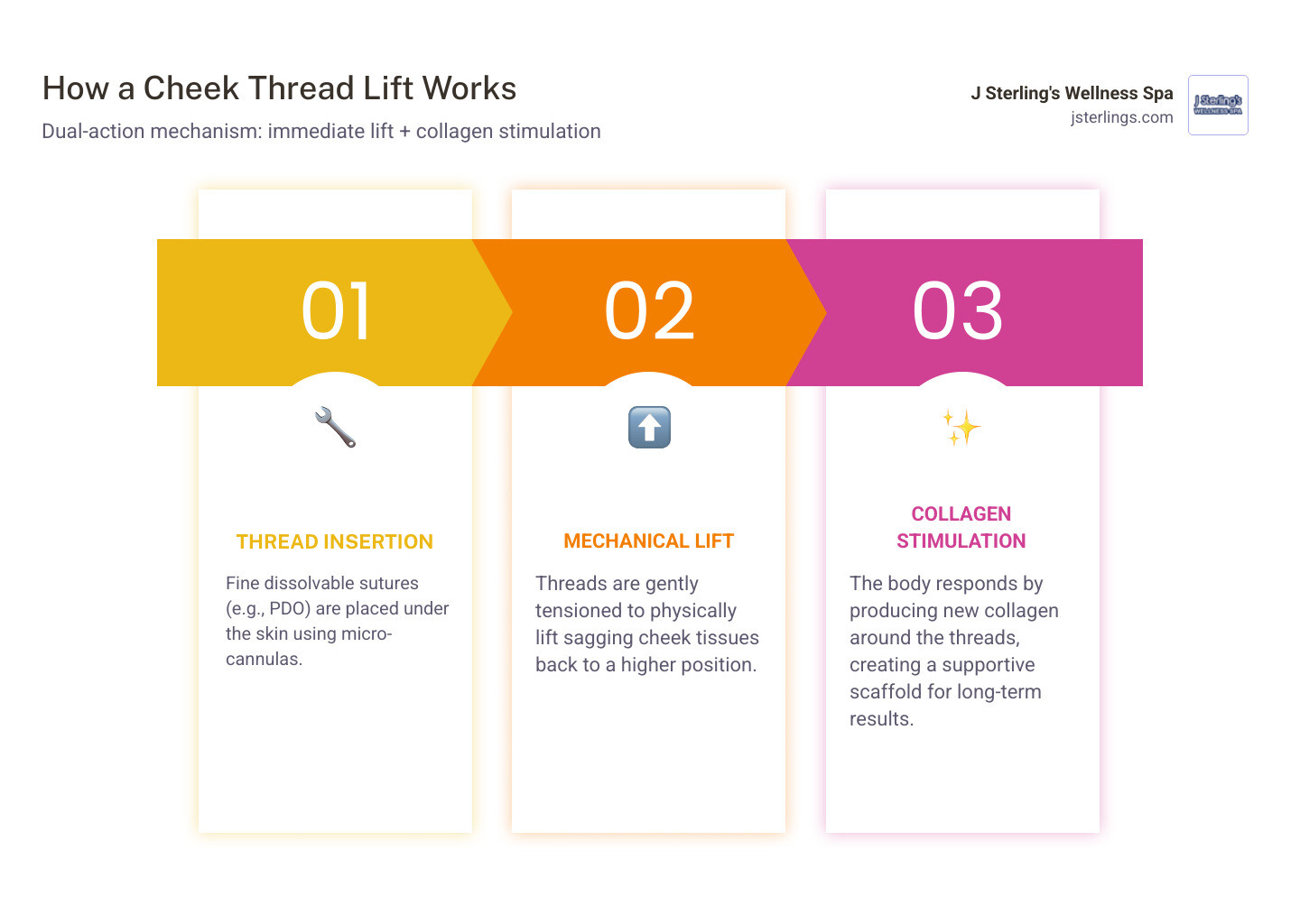
A cheek thread lift works through a clever dual-action mechanism. First, it provides an immediate, mechanical lift. When the threads are inserted and gently tensioned, they physically pull lax, sagging skin and subcutaneous fat back into a higher, more youthful position. Second, it triggers a biological lift. As the body detects a foreign object (the thread), it initiates a natural healing response, surrounding the suture with a fresh scaffolding of Type 1 collagen.
The threads themselves are made of fully biocompatible, medical-grade materials that have been used in cardiothoracic and general surgeries for decades. Over a period of 6 to 9 months, the body naturally dissolves and absorbs these sutures via hydrolysis. However, the structural network of newly formed collagen remains behind, keeping your cheeks looking lifted, firm, and beautifully contoured for up to 12 to 18 months. For a deeper look at the step-by-step process of how these medical-grade sutures physically reposition tissue, explore this comprehensive guide to cheek lifts with threads.
Barbed vs. Smooth Threads and Material Types
Not all threads are created equal. Depending on your anatomical needs, a practitioner will select a specific thread type or use a combination of different designs:
- Barbed (or Cogged) Threads: These are the workhorses of facial lifting. They feature tiny, microscopic hooks or cogs that cut into or mold along the suture. Once inserted, these barbs anchor firmly into the subcutaneous tissue, allowing the practitioner to physically grip and pull the sagging cheek tissue upward.
- Smooth (or Mono) Threads: These threads do not have barbs. Instead, they are typically inserted in a crisscross, mesh-like pattern. While they do not provide an immediate mechanical lift, they act as an excellent skin-tightening treatment by stimulating widespread collagen production in areas of fine wrinkling.
- Material Differences:
- Polydioxanone (PDO): The most common material, highly effective at boosting Type 1 collagen.
- Poly-L-Lactic Acid (PLLA) & Polycaprolactone (PCL): These materials dissolve more slowly than PDO threads, sometimes lasting up to 12 to 24 months, and can stimulate both Type 1 and Type 3 collagen for enhanced tissue elasticity.
The Role of the Supra-SMAS Layer in Thread Placement
Achieving a beautiful, natural-looking lift depends entirely on the depth of the thread placement. The facial tissue is organized into distinct layers: the skin (epidermis and dermis), the subcutaneous fat, the Superficial Musculoaponeurotic System (SMAS), the deep facial spaces, and finally, the periosteum (bone).
For a standard cheek thread lift, the absolute “sweet spot” is the supra-SMAS layer (the deep subcutaneous fat plane directly above the SMAS).
- Why the Supra-SMAS? This layer is highly safe because the major facial nerves and blood vessels run deeper, beneath the SMAS (sub-SMAS). Placing threads here protects these critical structures from injury.
- The Danger of Placing Too Superficial: If a thread is placed too high in the superficial dermis, it will cause visible skin irregularities, such as puckering, dimpling, or the thread itself becoming visible or palpable under the skin.
- The Danger of Placing Too Deep: Going sub-SMAS or intra-SMAS significantly increases the risk of hitting motor nerves, major arteries, or salivary glands, leading to serious complications.
Anatomical Considerations for a Safe Procedure
A successful cheek thread lift is not just about pulling skin; it is about navigating a complex, three-dimensional landscape of tissues, spaces, and vessels. To ensure absolute safety, practitioners must adhere to strict sterile protocols and use advanced medical tools. For instance, using blunt-tip micro-cannulas rather than sharp needles is a gold-standard safety practice. Blunt cannulas gently push blood vessels and nerves aside rather than cutting through them, significantly reducing the risk of bruising, hematomas, and nerve trauma. To understand the quality of medical-grade supplies required for these procedures, you can read more about Diaminy | Premium Aesthetic Micro Cannulas & Medical Supplies.
Target Fat Compartments and Aging
Facial fat does not exist as a single, continuous sheet. Instead, it is divided into distinct superficial and deep fat compartments. As we age, these compartments change in predictable but troublesome ways:
- Compartmental Sagging: Superficial compartments, such as the nasolabial fat and jowl fat, tend to lose their structural support and slide downward and medially. This descent is what creates the appearance of heavy smile lines and sagging jowls.
- Deep Volume Loss: Deep compartments, such as the deep medial cheek fat, deflate over time. This loss of deep structural support causes the overlying tissues to collapse inward, flattening the cheeks.
During a thread lift, the practitioner strategically places barbed threads to catch the sagging superficial fat compartments and shift them back upward and laterally to their original positions, restoring a youthful, heart-shaped facial contour.
Retaining Ligaments and the Line of Ligaments
Facial retaining ligaments act as strong, fibrous anchors that run from the deep bone or fascia all the way through to the skin, keeping our facial structures in place.
- Key Ligaments: The zygomatic cutaneous ligament (often referred to historically as McGregor’s patch) and the masseteric cutaneous ligament are crucial in the cheek area.
- The Line of Ligaments: This is an important vertical boundary line running lateral to the lateral orbital rim from the temporal crest down to the mandible.
- Lateral to this line, the facial tissues are highly fixed and stable, making this area the ultimate anchoring zone for thread placement.
- Medial to this line, the tissues are highly mobile.
- The T-Shaped Support System: The zygomatic and masseteric cutaneous ligaments intersect in a natural T-shape. This intersection provides an incredibly strong structural support system. By anchoring threads lateral to this line of ligaments, we can achieve a highly effective, stable lift in the mobile medial cheek.
Navigating Facial Spaces and Glands
Deep within the cheek lies the premasseteric space — a natural, low-resistance plane filled with loose connective tissue. While this space allows for smooth facial movement and expressions, threads placed too deeply can enter this space, causing a loss of tension and post-procedure discomfort when chewing or smiling.
Furthermore, the parotid gland (the large salivary gland located in front of the ear) and the submandibular gland must be completely avoided. If a thread is placed too deeply and punctures the parotid gland or its duct, it can cause saliva to leak into the surrounding tissues, leading to painful swelling, infection, or a salivary fistula. Maintaining a strict supra-SMAS depth ensures these glands remain completely untouched.
Managing Vascular and Nerve Risks
Because the face is highly vascularized and packed with sensory and motor nerves, a deep clinical understanding of facial mapping is vital to avoiding complications.
Avoiding Major Facial Arteries
There are several key blood vessels that run through the cheek and temporal regions:
- Superficial Temporal Artery (STA): This artery runs through the temple area, with its anterior branch traveling at an average angle of 60.8 degrees superomedially. If a practitioner accidentally punctures this artery during temporal anchoring, blood can pulse out rapidly within seconds. If this occurs, firm, continuous pressure must be applied for 3 to 5 minutes to achieve hemostasis.
- Zygomatico-Orbital Artery (ZOA): Present in approximately 85% of individuals, this artery runs across the upper cheekbone.
- Transverse Facial Artery & Facial Artery: These run across the midface and cheek. Puncturing them can lead to large, painful internal hematomas.
By using blunt cannulas and staying in the superficial supra-SMAS plane, the risk of intersecting these high-pressure vessels is minimized.
Minimizing Facial Nerve Injury
The facial nerve (Cranial Nerve VII) controls all muscles of facial expression. It splits into five main branches: temporal, zygomatic, buccal, marginal mandibular, and cervical.
- The Temporal Branch: This branch is highly vulnerable as it travels along the Pitanguy line (stretching from 0.5 cm below the tragus to 1.5 cm lateral to the eyebrow). Damage here can cause drooping of the forehead and eyebrow.
- The Zygomatic and Buccal Branches: These branches cross the cheek to control eye closure and smiling.
Because these are motor nerves, any trauma can lead to temporary or, in rare cases, permanent facial asymmetry. Fortunately, the temporal branch consists of 2 to 3 smaller, redundant branches rather than a single filament, which reduces the risk of complete paralysis if a minor irritation occurs. Staying superficial to the SMAS is the absolute best way to keep these nerves safe.
Ideal Candidates vs. Surgical Facelift
While a cheek thread lift is an exceptional procedure, it is not a direct replacement for a surgical facelift. It is important to understand what each option can realistically achieve:
| Feature | Cheek Thread Lift | Surgical Facelift (Rhytidectomy) |
|---|---|---|
| Invasiveness | Minimally invasive; in-office procedure | Highly invasive; surgical operating room |
| Anesthesia | Local numbing only | General anesthesia or deep sedation |
| Downtime | 24 to 48 hours of social downtime | 2 to 4 weeks of intense recovery |
| Results | Subtle, natural lifting and tightening | Dramatic repositioning and skin removal |
| Longevity | 12 to 18 months | 10 to 15 years |
| Ideal For | Mild to moderate skin sagging (ages 30–60) | Severe skin laxity and deep structural folds |
Ideal Candidates for a Cheek Thread Lift
The ideal candidate is typically between 30 and 60 years old, experiencing mild to moderate skin laxity, and looking for a natural-looking refresh rather than a dramatic transformation. It is also an excellent option for individuals who cannot undergo major surgery due to chronic medical conditions like diabetes or high blood pressure. To learn more about how thread lifts compare to other non-surgical aesthetic options, read our detailed guide on non-invasive cosmetic procedures.
Complementing Thread Lifts with Professional Facials and Skincare
To achieve the ultimate anti-aging result, we often recommend combining a thread lift with other treatments. While threads address tissue descent and structural sagging, they do not change the surface quality of your skin.
By pairing a thread lift with professional day-spa services — such as customized medical-grade facials, chemical peels, or laser therapies — you can treat surface sun damage, fine lines, and uneven skin tone at the same time. Ready to discuss a personalized treatment plan? You can easily schedule a consultation for facial services near me at one of our convenient locations.
Recovery, Longevity, and Complication Management
One of the greatest appeals of a cheek thread lift is the straightforward recovery process. However, proper aftercare is essential to ensure the threads anchor securely in place.
Recovery and Aftercare for a Cheek Thread Lift
While most patients can resume daily social activities within 24 to 48 hours, the internal healing process takes a bit longer. To keep your threads perfectly in place, follow these essential aftercare guidelines:
- Sleep Elevated: Sleep on your back with your head propped up on extra pillows for the first 3 days to minimize swelling.
- Gentle Face Washing: Do not wash your face for the first 24 hours. When you do resume, wash very gently and avoid rubbing or massaging your face for at least 5 days.
- Limit Facial Expressions: Avoid exaggerated facial movements, laughing excessively, yawning widely, or smiling for the first 7 days.
- Postpone Dental Visits: Avoid dental procedures for at least 2 to 3 weeks. Extreme stretching of the mouth can easily dislodge newly placed threads from their anchors.
- Exercise Restrictions: Avoid high-impact exercise, vigorous sports, saunas, and steam rooms for 1 to 2 weeks.
Longevity of Results and Maintenance
While the physical threads dissolve safely within 6 to 9 months, the structural collagen matrix they leave behind maintains your refreshed look. Most patients enjoy their visible lifting benefits for 12 to 18 months. To maintain these results long-term, many individuals choose to undergo minor touch-up treatments every year or year and a half.
Preventing and Managing Common Complications
Though rare when performed by a skilled provider, complications can happen. Here is how they are typically managed:
- Skin Dimpling or Puckering: This occurs when a thread barb engages a retaining ligament too tightly. Most minor dimples resolve on their own within a week as the tissue relaxes. If a dimple persists, a practitioner can perform a gentle, targeted massage technique to release the tension.
- Bruising and Hematomas: Minor bruising is common and typically resolves within 5 to 10 days. Applying ice packs and Arnica immediately post-procedure helps minimize this.
- Infection: If you notice localized redness, heat, or throbbing pain, contact your provider immediately. Infections are treated promptly with oral antibiotics.
- Thread Extrusion: Occasionally, the tip of a thread may begin to push through the skin. If this happens, your provider can easily trim the exposed end under sterile conditions.
Frequently Asked Questions about Cheek Thread Lifts
Is a cheek thread lift painful?
The procedure is highly tolerable. Before the treatment begins, local anesthesia is administered at both the entry and exit points of the threads. While you may feel some pressure, pulling, or tugging as the threads are adjusted, you should not feel sharp pain. Afterward, some mild soreness and tightness are normal for a few days and can be managed easily with over-the-counter pain relievers.
How many threads are typically used in a cheek lift?
This is highly customized to your unique facial anatomy and the degree of skin sagging. Typically, 2 to 4 larger barbed sutures are placed on each side of the face to create the primary lifting effect. However, depending on your goals, a session may involve anywhere from 1 to 15 individual threads per area to build a supportive, collagen-stimulating mesh.
Can a thread lift be reversed if I am unhappy with the results?
Yes. Because the sutures are made of dissolvable materials, they will naturally break down and be absorbed by your body over time. However, if you are highly uncomfortable or unhappy with the immediate results, a qualified plastic surgeon can physically locate and gently remove the threads.
Conclusion
A cheek thread lift is an outstanding, science-backed way to restore youthful structure, lift sagging tissues, and jumpstart your body’s natural collagen production — all without the risks, scars, or downtime of major surgery.
At J Sterling’s Wellness Spa, we believe that self-care and high-end aesthetic results should be both accessible and affordable. We combine budget-friendly luxury with highly trained, licensed professionals to ensure your experience is safe, comfortable, and beautifully tailored to your natural features.
Ready to refresh your look and restore your natural glow? Schedule a consultation for facial services near me today at one of our six convenient Orlando locations, and let us help you put your best face forward!